

 Teams
Teams SharePoint
 Slack
Slack QR Codes
 PDF
PDF Active Directory
 Workday
 ADP
ADP Canva
CanvaAI | Internal Communication
Why internal communicators are using AI

Let me paint you a picture: It’s a Tuesday, you’ve got a leadership update due, a newsletter that’s technically started, three “quick questions” in Slack, and a nagging feeling you were supposed to pull last month’s numbers by now… Sound familiar? 😅
If you’re anything like the comms folks we hear from, you’ve probably already opened an AI tool to help with at least one of those repetitive tasks. In our 2026 Internal Comms Trends Report, nearly half of communicators (48%) said they want to lean even further into AI this year!
So the interesting topic here is why internal communicators are using AI, and what communicators who are getting great results are doing differently. Here’s the honest breakdown, plus the practical tips I’d share with any comms team that wants to spend less time on busywork and more time on the messages that actually matter! ✨
Want to skip ahead and just try it? Chat with Cici — the AI agent built for internal comms!
Why internal communicators are using AI in the first place
Let’s be real, “YAY! Shiny new tech!” isn’t the typical mantra of an internal communicator, but hey – kudos if you fall in that category! Usually, the reason for using AI in this field stems from internal comms teams being almost always smaller than the job they’re handed.
Teams are expected to write more, personalize more, measure more, and cover more channels — usually with the exact same headcount you had last year (if not more!). And in the age of hybrid workplaces and global/frontline teams, the goal of “right message, right person, right time” has gotten gradually more difficult. And don’t get me started on the information overload everyone keeps talking about… *cough cough* it tends to land on the comms team’s desks first.
AI (when leveraged well) takes weight off that pile. It hands you a first draft so you’re editing for clarity and voice instead of staring at a blank page, reads the engagement report so you can spend your brain power on what the numbers actually mean for your org, and (my favorite): gives back the one thing this role never has enough of — time to think!
7 practical ways internal communicators are using AI today
None of these require a big rollout, a new budget line, or a fancy title — just practical habits we see making the biggest difference for comms teams.
1. Start with the drafts you secretly dread
Starting with drafts that you typically struggle to get off the ground is a smart place to start, because a first draft is low-stakes and easy to improve! Give the AI your bullet points, your audience, and the tone you’re going for, and let it hand you something to add your magic touch to.
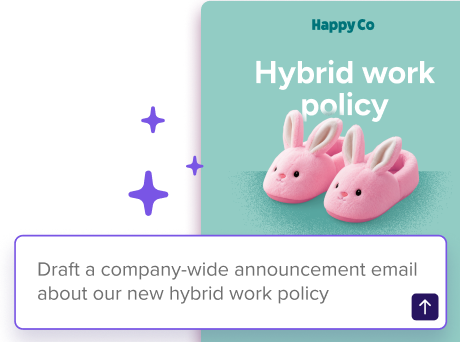
Try this: Ask Cici for “a warm, 150-word email to hourly employees explaining the new dental benefit — focused on what changes for them, with one clear CTA.”
2. Build a prompt library
Here’s your sign to stop rewriting the same request every month. Stop it!!!
Try this: If you send a monthly newsletter, write a prompt for AI once with your structure, tone, and non-negotiables baked in, and save it. Next month, you swap in the new content instead of rebuilding the instructions from memory. Over time you end up with a little library of reusable prompts for your recurring work: leadership updates, onboarding notes, event reminders, crisis-comms starters.
This is where the time savings really stack up! Bonus: check out our free AI prompt library if you want a running start at some prompts that really work.
3. Let AI read your analytics so you can interpret them
Instead of scanning screenshots, open rates, old sends, and a few Slack messages all by hand — you can hand it over to AI to surface the pattern, so you get to do the valuable part (aka deciding what it means and what to change). When pulling insights stops being a chore, you connect performance to real decisions about messaging, timing, and clarity way more often.
This is exactly the kind of thing Cici, Workshop’s built-in AI agent, was made for! Because Cici lives inside Workshop and is connected to your real campaigns and audiences, you’re not uploading spreadsheets or explaining context from scratch — it already knows your sends..
Try this: Ask Cici how last month’s newsletter performed and it’ll analyze the results, surface trends worth knowing about, and tell you what worked, what didn’t, and what to try next.
4. Use AI for the “before you hit send” checks
We know there are some checks you are manually running every single time, and those are perfect to hand off! I love this one because it catches the small stuff that quietly erodes trust. Think of it as a second set of eyes that never gets tired. (It’s not a replacement for your judgment, just a really reliable backup!)
Try this: Ask AI to perform confidence passes for tone and clarity, scans for jargon your frontline team won’t recognize, a gut-check on whether the actual ask is, you know, obvious or not.
5. Translate and adapt across channels
If you support a global or deskless workforce, this one is a no-brainer! AI can translate a message into multiple languages while keeping your tone and nuance intact, and it can reshape one update for different channels — the full version for email, a tight summary for Teams or Slack, a couple of lines for a text.
Try this: You don’t even have to leave your email to do it. Workshop’s translation feature builds a one-click translation block right into your message — 135 languages, with 31 powered by DeepL for extra accuracy. And for your deskless crew? Share the email’s web link and each person can read it in the language they’re most comfortable in, no app or login required.
6. Automate the recurring, low-judgment stuff
Once you trust AI with a task, the natural next step is letting it run on a schedule instead of waiting for you to kick it off. The goal isn’t to automate the thinking — it’s to automate the fetching, formatting, and first-drafting so the work is already half-done by the time you sit down to it. Start with one recurring task you could explain to a new teammate in two sentences. That’s almost always a safe, high-value place to begin!
Try this: Give AI this prompt – Every Monday, pull last week’s email numbers, summarize them, and flag anything that looks off.
7. Keep your comms knowledge portable
Don’t let your best thinking get trapped inside a single chat window. Your tone guidelines, your prompt library, your documented workflows… keep them as reusable assets that live outside any one tool. AI platforms change fast, and your communication strategy shouldn’t have to reset every time they do. Treating your prompts and standards like a shared team resource means new hires get up to speed faster, and your voice stays consistent no matter who’s at the keyboard.
Where I’d still keep a firm hand on the wheel
I’d be doing you a disservice if I made this all sound frictionless. The concern of “Will this make our messages feel less human?” is a fair one, especially in a job built on trust and tone.
Remember, voice goes flat when AI output gets copied and pasted without a human reading it like a human would. So the teams doing this well use AI in layers: High-stakes leadership messages, sensitive change comms, anything with real emotion behind it — a person drafts the heart of it first, and AI helps refine, tighten, or adapt it. Used that way, AI doesn’t dilute your authenticity. It protects your time so you have more of it for the messages that genuinely need a human touch.
So, where’s all this headed?
If there’s one throughline here, it’s this: internal communicators aren’t using AI to do their jobs for them. They’re using it to do the work of a bigger team with the one they’ve already got — drafting, analyzing, translating, and automating the busywork so their real expertise goes to strategy and the messages that matter.
But wherever you start, start small. Pick one dreaded draft, one recurring report, one “before you send” check — and let AI take the first pass. The time you get back is the whole point. ✨
And if you want to see what AI that actually knows comms feels like, you can chat with Cici for free right now — no account, no setup, no catch! Ask it for three subject line ideas, a first draft of that announcement you’ve been avoiding, or a gut-check on what counts as a good open rate. It’s built on Workshop’s research and the best practices of thousands of internal communicators, so the help you get actually fits your day (unlike the generic chatbot you’ve probably been wrestling with). 😉