

 Teams
Teams SharePoint
 Slack
Slack QR Codes
 PDF
PDF Active Directory
 Workday
 ADP
ADP Canva
CanvaAI | Email | Internal Communication | Intranet | Metrics
6 internal comms trends every communicator should know in 2026


If you’re planning your strategy for the year ahead, you’ve probably already felt it…internal comms is stretching in every direction. The expectations are bigger, the timelines are tighter, and somehow the inboxes are even fuller. And according to this year’s Internal Comms Trends Report (our biggest dataset yet!), 2026 is shaping up to be a year defined by smarter systems, clearer channels, and yes, a whole lot of AI and automation!
Here are the 6 internal comms trends every communicator should have on their radar as we head into the new year!
Let’s get into it. ✨
2026 Internal Comms Trends Report
See what’s top of mind for internal comms heading into 2026
Grab your free report!
1. Manager comms is still the #1 internal comms trend of the year
Some things are just inevitable: inbox overflow, a last-minute “quick edit,” and manager comms topping the trends list!
This year, 56% of communicators named manager comms as their top trend for 2026. And honestly? The data backs it up. Only 4% of respondents said managers are very effective at cascading communication today, and 17% say they’re only somewhat effective.

Managers are still the make-or-break moment between “message sent” and “message understood.”
Why does this matter? Employees trust their managers more than any other source. When leaders miss context, skip steps, or soften key messages, the entire cascade wobbles.
Here are a few practical ways you can help your managers communicate more effectively in your organizations:
- Leader digests that highlight what really matters
- Manager toolkits with copy, FAQs, timing notes, and talking points
- Dedicated manager channels or newsletters to reduce noise
- Short, focused training that helps managers confidently take on their part of the communication flow
- A Communication Cascade Template managers can use to share updates clearly and consistently If strengthening manager comms is on your 2
If strengthening manager comms is on your 2026 roadmap, our Manager Comms Kit brings everything together in one place — tools, templates, and ready-to-use resources that make it easier for managers to communicate with clarity and confidence. It’s one small kit that can take a lot of lift off your plate.
2. AI + automation are officially part of the workflow (and getting smarter fast)
AI officially moved from “trend” to “tool” this year, and the shift is unmistakable!
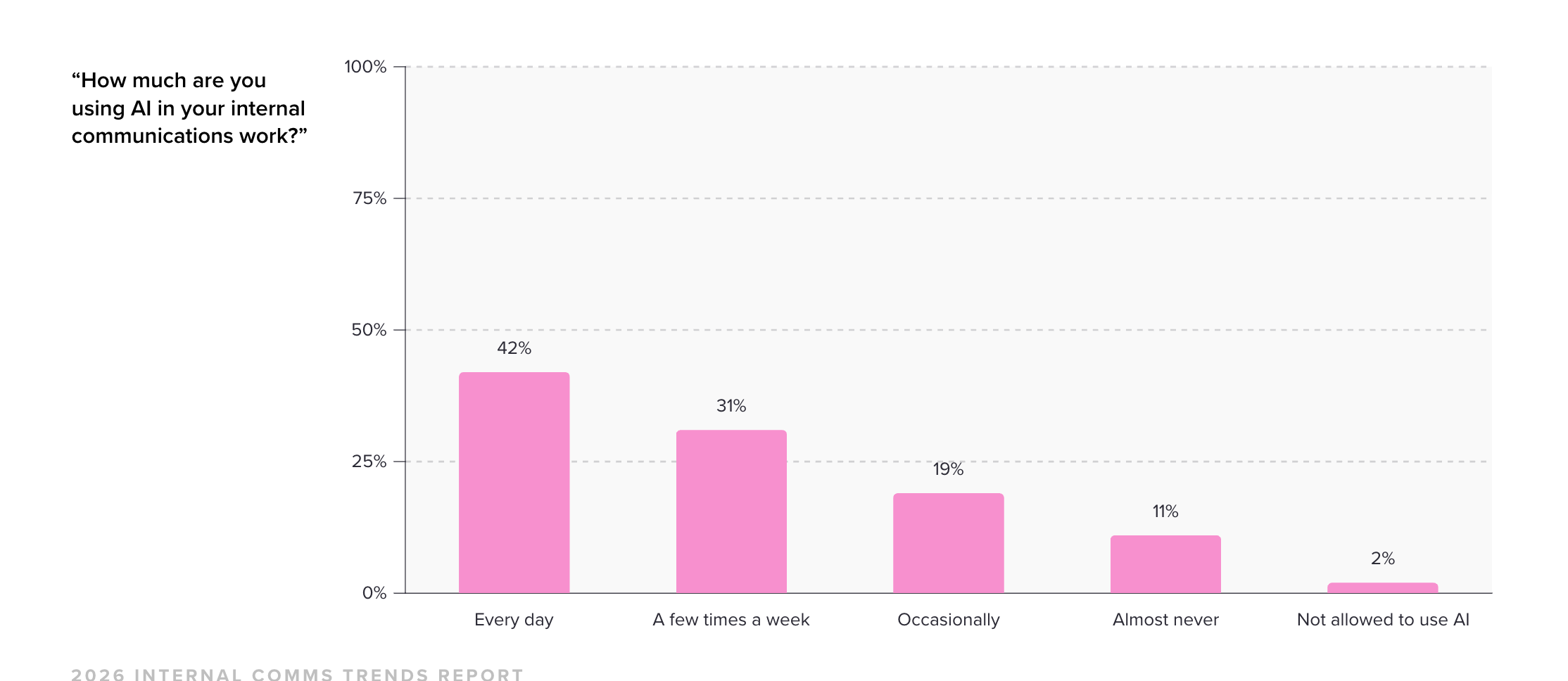
42% of communicators now use AI every day, and another 31% use it a few times a week. That means nearly three-quarters of internal communicators have already folded AI into their day-to-day.
Right now, the top AI use cases are:
- Content production (72%)
- Strategy and planning (47%)
- Summarizing employee feedback (44%)
- Repurposing content (41%)
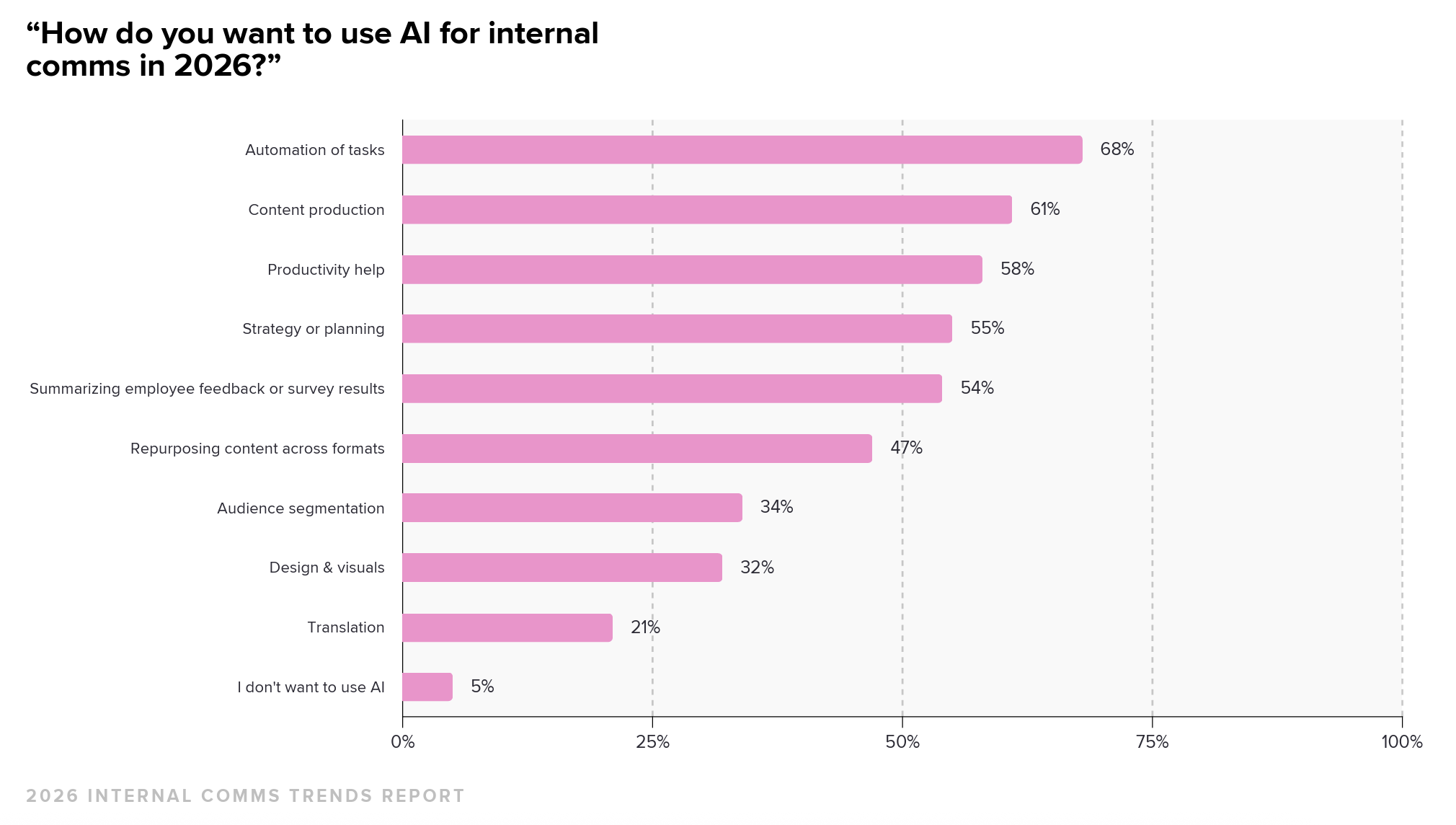
But the real shift is what teams want next! 68% want AI to automate repetitive tasks, and 61% want faster content workflows in 2026.
AI helps close the gap between idea and message so communicators can spend more time on the parts that truly need them (like the tone, the trust, the nuance, and the clarity).
3. Employee influencers (are they cringe-y or clever?)
We know, we know. The phrase employee influencers sounds like it belongs in a parody of corporate life. But in this year’s report, it shows up as one of the most genuinely human (and genuinely effective) trends to watch. 41% of communicators want to explore it in 2026, and for good reason!
When employees see people they know (and trust) reflecting company messages, everything feels a lot more relevant. Do this by highlighting the people who naturally translate complex updates into everyday language. Spotlight subject-matter experts. Let frontline voices help shape how information travels.
When you tap in the right people, employee influencers become clarity builders. They help messages land faster, feel more relatable, and stick longer — especially across large, hybrid, or distributed teams.
4. The most effective internal comms channel in 2026? Email (again!)
Some trends come and go, but email is not one of them. 😉
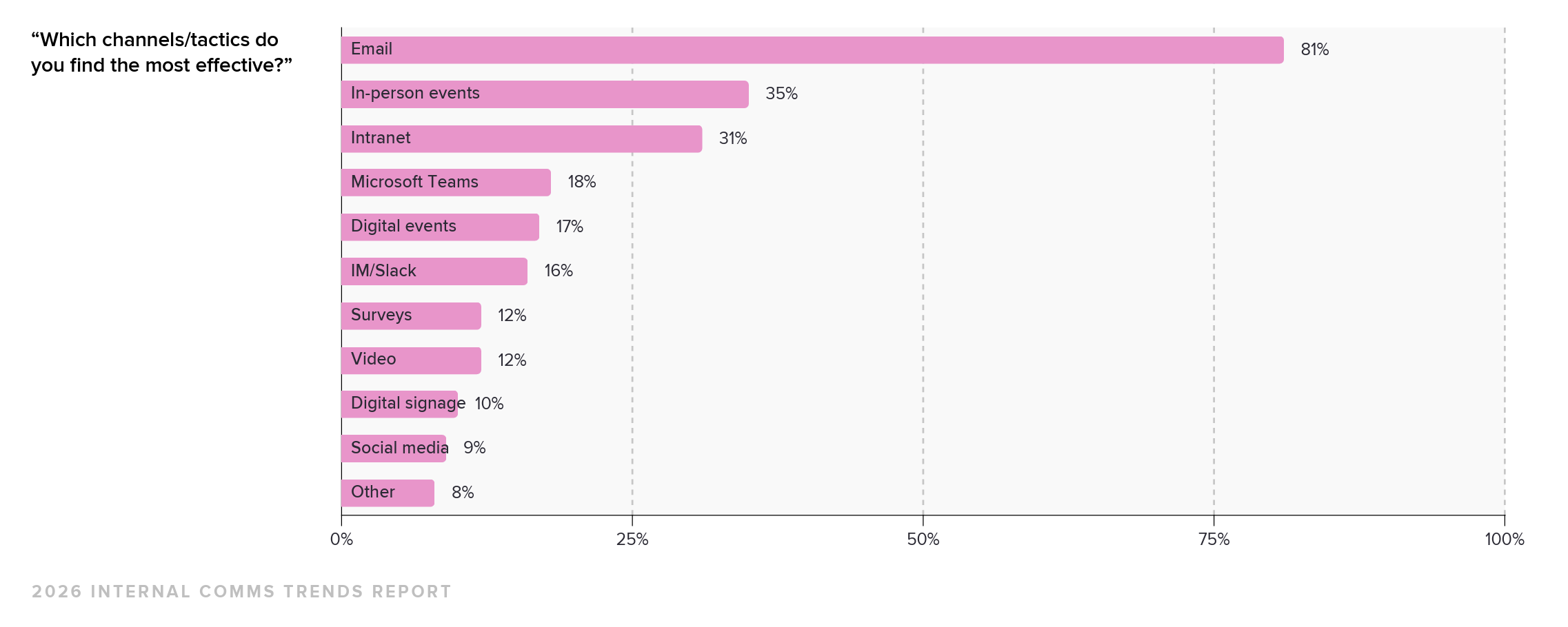
In this year’s report, 81% of communicators named email their most effective channel, far ahead of in-person events (35%) and intranets (31%). It’s still the anchor of internal comms!
And it makes sense why!
- It actually reaches everyone — not just desk workers
- It’s measurable (as in: real data, not vibes)
- It’s flexible for announcements, rollouts, storytelling, all-hands recaps, you name it
- It’s already where people look for work-critical updates
Also, email is predictable. Employees know where to look, when to look, and what they’ll find. And that consistency builds trust, which makes your other channels work even better.
Heading into 2026, Teams aren’t picking one “best” channel. They’re pairing strong push channels (like email and SMS) with intentional pull channels (like intranets or hubs) to create a system that meets employees where they are and supports them when they need to find something later. (More on this in a bit!)
5. “Do more with less” is finally getting some pushback
If 2026 has a running theme, it’s this: internal comms teams are being asked to carry more than ever…without getting much more to carry it with.
Only 44% of communicators agree or strongly agree that they have the resources they need to deliver on their strategy next year. That means more than half of internal comms teams are operating without the time, tools, or support they need to do the work well. And you can feel the collective “yep, that tracks” in the open responses we got. One respondent said, “We all wear way too many hats and rarely have time to strategize and execute big-picture projects.” The themes show up over and over again — an overwhelming stack of priorities and those “quick question!” requests that somehow turn into a full rewrite of a change-management plan.

It’s not just the volume, though. It’s the pattern! You’re looped in late, relying on tools that slow you down, often operating as a tiny team (or a team of one), and expected to show up as a strategic partner without ever getting the time or space to be strategic.
But under all of that pressure, something encouraging is taking shape. There’s a quiet shift toward boundaries, clearer expectations, and real support. Communicators are asking better questions, getting involved earlier, and building systems that protect their energy instead of draining it.
A few small (very human) things that help:
- Create a simple intake form. Not a 17-question form. Just enough to stop the drive-by requests and make people think before they toss something your way.
- Set the timeline before the work begins. A gentle, “If we want this to land well, here’s what the process looks like,” goes a long, long way.
- Build yourself a reuse library. Toolkits, templates, manager scripts, evergreen FAQs — anything you can do once and borrow forever.
- Let AI take the first swing. You’ll still fix the voice, sharpen the message, and add the humanity, but at least you’re not staring at a blank page!
- Protect your thinking time. Block it like a meeting.
- Practice the kind no. “We can do that, but not on this timeline. Here’s what is possible.” Clear, warm, and surprisingly liberating.
Internal comms are becoming more intentional and more boundaried. When the work aligns with your strategy and your capacity, it lands better. And you feel better doing it.
6. The intranet is both the most challenging channel and the top priority
The intranet made a very clear statement in this year’s Trends Report. 29% of communicators said the intranet is their most challenging channel, essentially saying, “this isn’t working right now.” And yet 52% put improving it at the top of their 2026 priority list. Teams aren’t abandoning the intranet altogether, but they’re rethinking what it should be.
The shift is happening in the mindset, not the technology. Instead of trying to maintain massive, everything-in-one-place sites, communicators are moving toward smaller, steadier hubs that support the rest of their tools. These hubs aren’t meant to replace email or Slack or texting — they’re meant to anchor them. To hold the evergreen pieces employees actually need: FAQs, policies, templates, how-to guides, and the resources that don’t change every day.
We outline this in our four essential tools framework we recommend:
- An internal comms email platform to get information directly to employees
- An employee texting tool for timely, urgent updates
- A real-time messaging tool for quick questions and collaboration
- A simple intranet or hub that employees can revisit when they need details
When these tools work together, no single channel carries the entire load — which is exactly the problem the intranet has been struggling under for years.
Push channels (like email) get the message out with clarity and reach. Pull channels (like intranets or hubs) give employees a reliable place to revisit the information. When they work in unison, communication feels calmer, clearer, and far more intentional.
If you want a deeper look at how the ecosystem fits together, we broke down the four must-have tools for every modern internal comms team.
Final thoughts
When you zoom out and look at this year’s Trends Report as a whole, we’re seeing that internal comms teams aren’t trying to do more for the sake of doing more. They’re choosing smarter systems, clearer channels, and work that actually supports employees. And even though expectations keep rising and resources aren’t magically expanding, communicators are finding new ways to make the work feel more doable (and more meaningful).
Across every trend, you can see the field maturing in real time. Manager comms is getting more structured, measurement is shifting from guesswork to clarity, AI is becoming a real teammate instead of a novelty, employee voices are gaining visibility, and teams are finally embracing a channel mix that feels intentional and rooted in how people actually work.
If you haven’t downloaded the full 2026 Internal Comms Trends Report yet, it’s absolutely worth the read. You’ll see the patterns behind the data, the quotes that shaped these themes, and the places where your own experience might feel remarkably validated.
And if any of these trends spark ideas (clearer emails, stronger manager comms, lightweight hubs, or AI that takes something off your plate instead of adding more to it) Workshop’s here to help you bring them to life!