


 Teams
 SharePoint
 Slack
 QR Codes
 PDF
 Active Directory
 Workday
 ADP
 Canva
AI | Email | Internal Communication | Metrics | Productivity | Tools
The 18 internal communication metrics to track in 2027
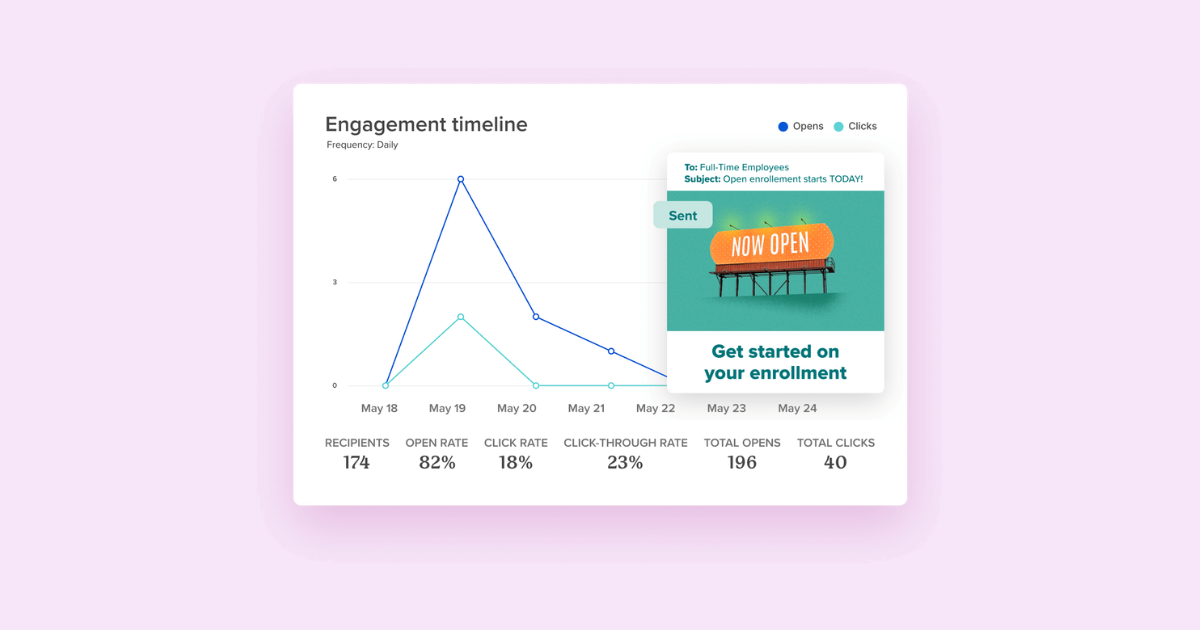

Internal comms can borrow from many of the tried-and-true metrics of external marketing, but it also deserves its own unique set of internal communication metrics.
After all, you aren’t dealing with hundreds of thousands of contacts; this audience is particularly unique. This audience is made up of the people you work with every day and the team you’ve built; this isn’t a list of leads, these are your coworkers.
It’s not enough to simply see open and click-through rates of email and text messages, but to see and segment the data in ways where you can truly measure engagement (by role, department, employee, or location).
What are internal communication metrics?
Internal communication metrics are the numbers that show whether employees receive, read and act on the messages you send. They include direct measures like open rate, click-through rate and read time, and indirect measures like engagement scores, retention and progress toward company goals.
A quick tip before we dive in: segment everything you can by role, department, location and manager. A 70% open rate overall can hide a 30% open rate on your frontline team, and that’s the number that tells you where to act.
When it comes to measuring the overall effectiveness of internal communications, it’s most important to select key performance indicators (KPIs) that you can have a direct effect on. To start tracking these regularly, try our internal communications metrics dashboard! While tracking employee engagement data or turnover rates is great, those are indirect measures of your success; there are hundreds of reasons outside of internal communications that could increase or decrease those numbers.
Luckily, there are plenty of internal communication metrics and KPIs that can be tracked and directly tied back to internal communications. Track yours below!
Bonus! Grab your free copy of our editable internal comms metrics dashboard below. You can start tracking yours today 🙂
Internal Communications Metrics Dashboard
It's easy to track and share the most important internal communications metrics with this easy dashboard template!
 Google Sheet

| Direct metrics (you influence these) | Indirect metrics (your work contributes) |
|---|---|
| 1. Open rate | 12. Employee engagement scores |
| 2. Click-through rate | 13. Progress toward company goals |
| 3. Read time | 14. Customer success metrics |
| 4. Engagement by segment | 15. Marketing metrics |
| 5. Channel effectiveness | 16. Key business metrics |
| 6. Campaign effectiveness | 17. Turnover and retention |
| 7. Program and event sign-ups | |
| 8. Traffic to key internal pages | |
| 9. Employee advocacy | |
| 10. Internal communications survey results | |
| 11. Audits and self-assessments |
From here, we’ll dig into each metric a bit more deeply, and tell you how you can most effectively measure them!
Want the full how-to for each number? Our internal communications analytics glossary walks through every formula, where to pull the data and how to turn it into an ROI story.
A note on measuring metrics in 2027
One thing has changed the day-to-day of measurement more than anything else in the last couple of years: you no longer have to pull, stitch, and interpret all of this data by hand!
Cici, Workshop’s AI agent for internal comms, is connected to your real recipients, engagement history, and campaign performance. So instead of exporting spreadsheets and squinting at trend lines, you can just ask. “Which department has the lowest open rates this quarter?” “How did my last newsletter perform with frontline employees?” “What’s driving the drop in clicks on our benefits emails?” You get specific, act-on-it answers grounded in your data — not a generic best-practices blog.
We’ll point out where Cici can save you time as we walk through each metric below. (Meet Cici here!)

Direct ways to measure internal communications metrics
These are the metrics that tend to make the best goals and KPIs for any internal communications role. You can directly affect the outcomes of these benchmarks through strategic planning and execution.
1. Open rate
Open rate tells you how many employees saw your message land. Benchmark against your own past sends rather than other companies, because audiences and tools vary so much.
Two things to know: Apple’s Mail Privacy Protection can inflate opens, and Outlook group sends can’t track opens per person. A dedicated internal email tool solves both.
- Formula: unique opens ÷ emails delivered × 100
- Where to find it: your internal email platform’s send report
- Benchmark: 73% median across Workshop customers; the top quartile hits 83% (2026 Internal Communication Benchmarks report)
2. Click-through rate
Click-through rate shows whether people took the next step. Since privacy changes made opens less reliable, this is often the most trustworthy signal of email effectiveness.
- Formula: unique clicks ÷ unique opens × 100
- Where to find it: your email platform’s link report
- Benchmark: 15% average click-through rate (clicks ÷ opens) and 11% average click rate (clicks ÷ recipients) across Workshop customers. Text-only emails reach 19% CTR vs. 15% for emails with images.
3. Read time
An open doesn’t mean someone read the message. Read time shows how long people actually spent with it. Compare it with how long the message should take to read using our free read time calculator.
- Formula: share of opens that were read (8+ seconds), skimmed (3–8 seconds) or glanced (under 3 seconds)
- Where to find it: internal email platforms that track time in message. Benchmark: 77% of opens are read, 8% skimmed and 15% glanced across Workshop customers.

4. Engagement by segment
Break your engagement data down by employee, team or location to spot patterns. If one site consistently reads less, that’s your cue for a manager reminder, a different channel or a quick one-on-one.
- Formula: any metric above, filtered by segment
- Where to find it: platforms connected to your HRIS so segments stay current

5. Employee text message metrics
With a robust employee text messaging service like Workshop, you can track the performance of text messages to and from your team just as effectively as email. We recommend targeting and segmenting your text messages to the right groups, so you can build a solid understanding around how people are interacting with your communications and where to improve. Make sure to look at:
- Replies: Two-way text messages give employees the ability to ask questions, respond to surveys, or confirm they got information. If you’re asking for replies, keep track of how well your calls-to-action perform over time.
- Opt-outs: When texting employees, you have to give them the option to opt out. A platform like Workshop measures how many opt-outs you get for each message, so you can understand what kind of communications your employees want.
- Clicks: Including links in text messages – to the intranet, to a sign-up or survey, to a website – is one of the best ways to deliver content to employees no matter where they are. Keep track of how well people engage with your texts by measuring click rate.
- Deliverability: A solid text messaging platform will tell you how many of your sent texts were delivered. You’ll know if you have problems with your lists or employees who need to update their contact information.
- Formula: unique clicks ÷ messages delivered × 100
- Where to find it: your employee texting platform
- Benchmark: 29% median SMS click rate (nearly 3× email’s 11%) and a 3% average opt-out rate
6. Channel effectiveness
Every channel has its own signals. Track intranet logins and page views, Slack or Teams reactions and replies, SMS opens and clicks, video views or event attendance, and how often managers hold one-on-ones.
- Formula: engagement on a channel ÷ people who received it on that channel
- Where to find it: each channel’s native analytics. Benchmark: Workshop SMS sends earn a 29% median click rate, nearly 3× the 11% average for email.
7. Campaign effectiveness
Group related messages into one campaign, like onboarding, open enrollment or a product launch, and measure the whole series together. One email rarely tells the story; five emails and a Slack post usually do.
- Formula: campaign goal completions ÷ people targeted
- Where to find it: campaign tags in your email platform, plus the goal system (benefits portal, LMS, etc.)

8. Program and event sign-ups
When your message asks people to register for something, sign-ups are the cleanest proof it worked. Compare registrations before and after each send.
- Formula: sign-ups after a send − sign-ups before it
- Where to find it: your registration tool or form
9. Traffic to key internal pages
Point every channel to one destination, like a benefits page or policy hub, and measure page views and comments. Add UTM parameters to each link so you know which channel drove the visit.
- Formula: page views (or unique visitors) by UTM source
- Where to find it: intranet analytics or Google Analytics
10. Employee advocacy
Employee advocacy measures how often employees share company content, mostly on LinkedIn. Focus on participation, top contributors and traffic from social referrals rather than raw impressions. Our 19-page employee advocacy guide has the full playbook.
- Formula: employees who shared ÷ employees invited to share × 100
- Where to find it: your advocacy tool or LinkedIn analytics
11. Internal communications survey results
A survey every 6–12 months gives you a baseline and shows change over time. Ask how employees prefer to get information, how informed they feel and which channels they trust. Start with our survey template.
- Formula: % of favorable responses per question, compared with your last survey
- Where to find it: your survey tool
12. Audits and self-assessments
A communications audit takes stock of every channel, message and owner so you can spot overlap and gaps. Pair it with a self-assessment of your own processes once a year.
- Formula: count of channels, sends per month and owners per channel, compared year over year
- Where to find it: a simple spreadsheet inventory of your channels and sends
Indirect ways to measure internal communications metrics
Indirect metrics are business outcomes your work contributes to, alongside many other factors. You won’t own them alone, but tracking them next to your direct metrics shows leadership where communication is pulling its weight.
13. Employee engagement scores
Internal comms connects teams across the company, so engagement results are worth a close look. Ask HR for the full survey results, not just the headline score, and look for questions about feeling informed or connected.
Where to find it: your annual or pulse engagement survey
14. Progress toward company goals
Employees can only work toward goals they understand. Track whether teams hit the goals you communicated about, and whether employees can name the company’s top priorities in your survey.
Where to find it: OKR or goal-tracking tools, plus a survey question on goal awareness
15. Customer success metrics
Informed employees, especially frontline and support teams, give customers better answers. Watch satisfaction scores and resolution times after major internal updates, like a new product or policy.
Where to find it: CSAT, NPS or support ticket data from your customer success team
16. Marketing metrics
Employees can be your best brand ambassadors during launches and campaigns. Track social shares, referral traffic and event registrations that come from employee networks.
Where to find it: your marketing team’s web analytics and social reports
17. Key business metrics
Communication gaps can show up as safety incidents, missed deadlines or productivity dips. Pick the one or two business numbers your leaders already care about and watch them alongside your campaigns.
Where to find it: operations, safety or finance dashboards
18. Turnover and retention
When people feel disconnected, they’re more likely to leave. A rise in turnover on one team can signal a communication gap worth a closer look.
Where to find it: your HRIS turnover and retention reports, filtered by team or location

How to build an internal communications metrics dashboard
A simple dashboard keeps your metrics in one place and makes monthly reporting take minutes instead of an afternoon. Start with our free internal communications metrics dashboard and organize it in three rows:
- Top row: 3–4 direct metrics. Open rate, click-through rate, and read time for the month, each with last month’s number beside it.
- Middle row: your current campaign. One goal (like open enrollment completion) and its progress toward target.
- Bottom row: 1–2 indirect metrics leadership cares about. Engagement score, retention, or a goal-awareness survey result, updated quarterly.
Keep it to one screen, segment by department or location where you can, and add a one-line note on what you’ll try next month.
How to start tracking your internal communication metrics
Start small. Pick three direct metrics, set a baseline from your last three months of sends and check them monthly. Add one indirect metric once you have a quarter of data.
Workshop tracks open rate, click-through rate, read time, segment-level engagement, channel and campaign effectiveness, and program sign-ups for you, so your numbers are ready when leadership asks. When you’re ready to calculate each one and connect it to ROI, our internal communications analytics glossary has the step-by-step.
Learn more about Workshop and request a demo here!
Internal communication metrics FAQ
What are the most important internal communication metrics?
Start with click-through rate, read time, and engagement by segment. They show whether employees read and act on your messages, and you can improve them quickly.
What’s the difference between internal communication metrics and KPIs?
A metric is any number you track. A KPI is the small set of metrics tied to a specific goal, like “80% of employees complete open enrollment by November 15.”
What’s a good open rate for internal emails?
The median internal email open rate across Workshop customers is 73%, and the top quartile reaches 83%. Compare against your own past sends first, since audiences vary so much.
How often should you report on internal communication metrics?
Monthly for direct metrics, and quarterly for indirect metrics and survey results, works for most teams.
Want to know how your numbers stack up? Download our latest internal communications benchmarks report to see open rates, click-through rates, and engagement broken down by industry and audience.