

 Teams
 SharePoint
 Slack
 QR Codes
 PDF
 Active Directory
 Workday
 ADP
 Canva
Internal Communication | Metrics
How to measure internal communications (with KPI examples)

You measure internal communications by tracking three things in order:
First, did your message reach people? Second, did they engage with it? Third, did it change what they know, feel, or do? Pick one or two KPIs at each level, set a baseline, and check them on a regular schedule.
That’s the core of it. Below, you’ll find 10 internal communication KPI examples, a step-by-step process for measuring internal communication effectiveness, and tips for sharing results with leadership.
If you’ve ever hit send on an important update and then wondered who actually read it, this guide will help you find out.
Why measuring internal communications matters
Sending a message is only half the job. Measurement tells you what happened after it landed, and that helps you in a few ways:
- You can show your impact. It’s much easier to get budget and buy-in when you can point to numbers. Clear data shows how your communications support goals like retention, change adoption, and safety.
- You can improve faster. Data shows which subject lines, channels, and send times work for your employees, so you can keep refining what you send.
- You can protect attention. When you know what employees actually read, you can cut the messages that aren’t landing and save their focus for the ones that matter.
You don’t need a data team or a complicated dashboard to get started. A handful of KPIs and a regular time on the calendar to review them will take you far.
The three levels of internal communication measurement
Every internal communications KPI fits into one of three levels. Each level depends on the one before it. People can’t engage with a message they never saw, and they can’t act on one they didn’t understand.
| Level | The question it answers | Example KPIs |
|---|---|---|
| 1. Reach | Did the message get to the right people? | Delivery rate, open rate, unique views |
| 2. Engagement | Did people pay attention and interact? | Click rate, read time, reactions and comments |
| 3. Impact | Did it change knowledge, attitudes, or behavior? | Message recall, survey sentiment, action completion |
Most teams start with reach because it’s the easiest to track. Engagement and impact tell you much more about whether a message worked, though, so aim for at least one KPI at every level.
10 internal communication KPI examples
Pick the ones that fit your goals and start with three to five. (For formulas and definitions of every metric, see our internal communications metrics glossary.)
Reach KPIs
1. Delivery rate
The percentage of employees who received your message. A low delivery rate usually means your distribution lists are out of date, or some employees don’t have a company email address, which is common on frontline teams. Your email or intranet platform should report this, and it’s the first number to check when other results look off.
2. Open rate
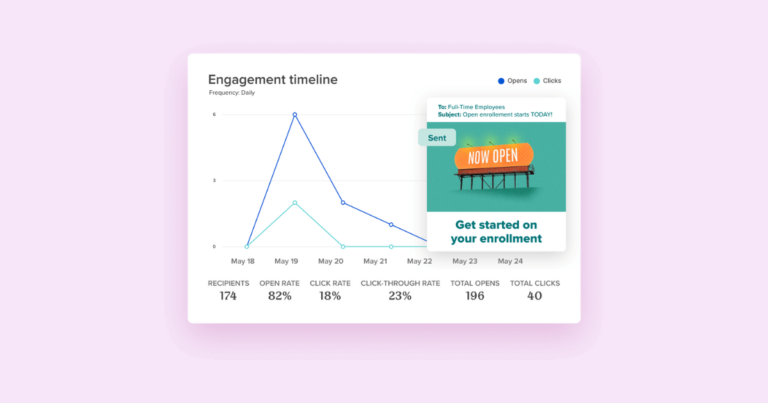
The percentage of recipients who opened your email or viewed your post. It’s the fastest way to tell whether your subject line and send time caught people’s attention. Track it by message and by audience. A 70% open rate at headquarters can hide a 30% open rate on the plant floor.
3. Channel reach
How many unique employees each channel reaches in a month. This shows you which channels (email, intranet, Slack or Teams, digital signage, manager huddles) reach the most people, and who isn’t being reached at all.
Engagement KPIs
4. Click rate
The share of recipients who clicked a link in your message. Clicks show intent: someone wanted to learn more or take a step. Compare click rate to open rate (click-to-open rate) to see how well the content itself performed.
5. Read time
How long people spend reading your message. If your open rate is strong but read time is only a couple of seconds, the subject line worked and the content didn’t hold attention. Use read time to test length, layout, and where you put your most important point.
6. Reactions, comments, and replies
How many people respond to your message, and what they say. Pay close attention to questions. If lots of people ask the same thing, you know exactly what to clarify in your next update.
7. Employee-generated content and participation
How many employees post updates, share stories, nominate peers, or attend events and town halls. Rising participation is a good sign that people feel connected enough to contribute.
Impact KPIs
8. Message recall and understanding
Whether employees can remember and explain your key messages. To measure it, send a short pulse survey a week or two after a big announcement with a question like, “What’s the main goal of our new benefits program?” Recall is one of the most direct ways to measure internal communication effectiveness.
9. Communication satisfaction and sentiment
How employees feel about the communications they receive. Add two or three questions to your engagement survey, such as “I get the information I need to do my job well” and “I understand where the company is headed.” Then track the scores over time.
10. Action completion and behavior change
Whether people did what your message asked them to do, like enrolling in benefits, finishing a training, acknowledging a policy, or using a new tool. Leaders tend to care about this KPI most because it connects communication directly to business results.
How to measure internal communication effectiveness, step by step
Measurement works best as a simple process you repeat. Here’s how to set one up.
- Start with the business goal. Ask what the company needs this quarter, such as faster change adoption, better retention, or fewer safety incidents. Your communication goals should support it.
- Define what success looks like. Turn the goal into a specific outcome, like “90% of managers complete the new review training by March 31.”
- Choose your KPIs. Pick one or two at each level: reach, engagement, and impact. It’s better to track a few KPIs consistently than a long list once.
- Set a baseline. Pull your current numbers before you change anything, so you have something to compare against later.
- Segment your audience. Break results down by location, department, role, or desk vs. frontline. Company-wide averages can hide the teams that need the most support.
- Gather qualitative feedback. Your numbers show what happened. Pulse surveys, focus groups, and manager check-ins help explain why.
- Review on a regular schedule. Check reach and engagement monthly and impact quarterly. Keep notes on what you tried and what changed.
- Act on what you learn. Test one change at a time, like a new subject line style, a shorter format, or a different send day, and measure the result.
Each time you go through these steps, you’ll learn a little more about how your employees prefer to hear from you.
How to share results with leadership
Leadership probably won’t want to see every metric. Focus on what changed and why it matters to the business. A few tips:
- Lead with impact. Open with the outcome (“Benefits enrollment hit 94%, up from 81% last year”), then show the reach and engagement numbers that got you there.
- Show trends over time. A single month’s open rate doesn’t say much on its own. Six months of steady improvement shows real progress.
- Connect to their priorities. Tie each KPI to a goal leadership already cares about, like retention, productivity, or change readiness.
- Bring a recommendation. End every report with one clear next step, such as “Add SMS for frontline teams to close the reach gap.”
A one-page monthly summary is usually enough. Use the same format each month so leaders know where to look.
To recap: pick a few KPIs across reach, engagement, and impact, set a baseline, and review your results on a regular schedule. Small improvements add up, and soon you’ll be able to answer “Is anyone reading this?” with real numbers.
Want to see opens, clicks, and read time in one place? Take a look at Workshop’s email analytics.
Measuring internal communications FAQs
Compare results against a clear goal and a baseline. Combine quantitative KPIs, like open rates and completion rates, with qualitative feedback from pulse surveys and managers. Effectiveness means the message changed what people know, feel, or do.
Track reach and engagement for every major send and review them monthly. Measure impact, like recall and sentiment, quarterly or after big announcements.
Email analytics, intranet analytics, and employee surveys cover most needs. An internal communications platform that tracks opens, clicks, and read time across audiences saves you from stitching data together by hand.
Start with open rate (reach), click rate (engagement), and action completion (impact). Together they show whether people saw your message, cared about it, and acted on it.