

 Teams
Teams SharePoint
 Slack
Slack QR Codes
 PDF
PDF Active Directory
 Workday
 ADP
ADP Canva
CanvaInternal Communication | Metrics
The biggest internal communications challenges (and how to solve them)
From information overload to invisible impact, here are the internal communications challenges most companies run into, and practical ways to work through them.


If you’ve spent enough time in internal comms you know that nobody warns you how much of the job happens before you ever hit send. By the time a message goes out, you’ve already chased down three stakeholders, guessed at which channel will actually get read, and quietly hoped the metrics will hold up if anyone asks whether it “worked.”
So when we ran our 2026 Internal Comms Trends Report and surveyed hundreds of internal communicators, I wasn’t shocked by much of it. One number stuck with me anyway though…73% said their internal comms strategy needs to change for the year ahead. That’s most of the field telling us the old playbook doesn’t hold up anymore.
What follows is a list of the internal communications challenges we hear about most here at Workshop, mixed with what our own survey data backs up, plus what’s actually worked for the teams we’ve talked to.
1. Information overload
Your message usually has twelve other messages competing for the same five seconds of attention, and most days it loses. Gallagher’s State of the Sector found that 83% of communicators call information overload a growing problem, and that number feels low to me. Between leadership updates, benefits reminders, team news, and whatever else popped up that week, inboxes fill up fast.
Be deliberate about who gets what, and when. Segment your audience so people only get what applies to them. Build a rhythm, like a weekly digest instead of five separate emails, so people know what to expect. Give yourself permission to act like an editor instead of a megaphone. Not every update needs to reach everyone.
Workshop’s personalization tools let you build segmented lists and dynamic content by role, location, or department, so a single send can look different for every group without you writing five versions of it.
2. Getting content and buy-in from the rest of the company
This is the one nobody talks about enough, and it was the single most common challenge in our own trends report. Getting content from other people and departments topped the list at 61%. Another 48% said they still aren’t looped in early enough to shape a message before it goes out, and 36% said they’re fielding too many one-off requests from other teams. A lot of comms people are stuck reacting to whatever lands in their inbox instead of helping plan it.
There’s no clever tactic that fixes this. It comes down to process. A simple intake form does more than you’d think to replace “just send this” requests with something closer to a real partnership. So does making it a habit to ask for a seat at the planning table, not just the announcement. One person in our survey put it bluntly: stakeholders write their own emails and hand them off to comms with instructions to “just send,” instead of inviting comms in earlier as a partner. Changing that starts with you setting the expectation.
3. Messages that get lost or ignored
Even when you’re sending less, there’s no guarantee it lands. In our trends report, 63% of communicators say their channels are at least somewhat effective at reaching employees, which also means over a quarter are still coming up short. That’s a hard number to sit with, especially once you see what employees actually say they value. In our survey, clear and transparent messaging, timely updates, and useful resources all tied for the top spot at 61%.
Usually the culprit is relying on one channel and hoping it works for everyone. Meeting people where they already are, whether that’s email, SMS, Slack, or Teams, makes a real difference. So does writing for a quick scan (clear subject line, the important part up top, and formatting that doesn’t demand a second read). A message that takes ten seconds to absorb beats one that takes two minutes, every time.
4. Reaching a hybrid, remote, or distributed workforce
If your team spans time zones, splits between office and home, or includes people who aren’t sitting at a desk at all, one-size-fits-all communication rarely works for everyone at once. What lands with your headquarters team might completely miss someone on a different shift or in a different location. (This gets especially sharp in frontline-heavy industries like healthcare. We wrote a deeper breakdown of those challenges here if that’s closer to your world.)
The most reliable fix is meeting people where they already are, instead of expecting them to come find you. That could be email and SMS, a mobile-friendly page, or a channel that doesn’t require a company laptop to open. Once you’re reaching people through whatever they’re actually checking, you stop quietly leaving part of your workforce out of the loop.
5. Getting managers to deliver a consistent message
Managers are often the most trusted messengers in a company, and also the most likely to go off script. They’re busy, and “here’s the exact wording” rarely reaches them in a form they’ll actually use. In our 2026 survey, only 4% of communicators said managers at their organization are very effective at cascading communications. Manager comms has also landed as the number one trend communicators want to focus on, two years running now.
Give managers something easy to use, not just information to relay. Talking points instead of a wall of context. A pre-written message they can personalize instead of a blank page. The easier you make it for a manager to communicate well, the more consistent the message will be by the time it reaches their team.
6. Communication that only goes one way
A lot of internal comms teams spend most of their energy broadcasting, sending updates out with no real way for employees to respond, ask a question, or say what’s actually landing. That’s a missed opportunity. People trust and engage with communication more when it feels like a conversation instead of an announcement.
Small changes go a long way here. A two-question pulse survey tucked into an email. A comment thread on an announcement. A simple way to flag “I have a question about this.” You don’t need a new tool for every idea, just a low-effort way for people to provide feedback or share their thoughts and opinions.
7. Proving that internal comms actually works
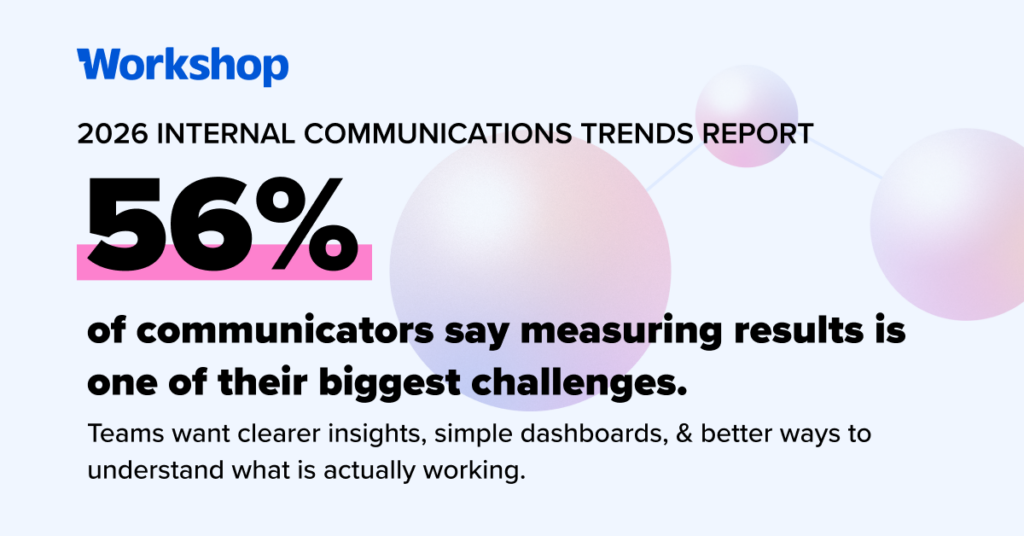
This is where internal comms loses its case as a strategic function. It’s hard to prove the mission mattered when most of what gets measured is opens and clicks. Gallagher found that while 70% of teams track output metrics like page views, only 16% measure employee sentiment, and just 12% connect their work to business outcomes. Our trends report backs this up from the other side: 56% of communicators told us measuring results is one of their biggest ongoing challenges, and 38% called out proving ROI specifically.
Open rates matter, but they’re not the whole story! Try tying a campaign to something the business already cares about. Did onboarding communications reduce new-hire questions to HR? Did a benefits campaign move enrollment? These types of metrics are the numbers that earn internal comms a seat at the table! If you’re curious, we did a deep dive on the metrics we recommend tracking.
8. Doing all of this with a small, sometimes solo, team
Most internal communicators aren’t working with a big team or a big budget. Only 44% said they have the resources they need to deliver on their current strategy. 39% pointed to “not enough time in a day” as a top challenge, and 42% said a lack of automation in their process is actively holding them back. They’re writing emails from scratch, chasing approvals, formatting for five channels, and trying to think strategically with whatever time is left. That’s a lot to carry, and it’s why so many good ideas never make it past the “someday” list!
This is exactly the gap Cici, Workshop’s built-in AI assistant, is meant to fill. Hand it a rough draft or a handful of talking points and it’ll turn them into something ready to send (and on-brand) in a few minutes, using your own campaign data to suggest timing and channel, too. None of that replaces your judgment, but it gives you back the hours you’d otherwise spend on the repetitive stuff, and for a team of one or two people, that time adds up.
How Workshop helps with all of it
Every internal comms team we talk to is working through some mix of these same eight, which is exactly why we built Workshop around this list instead of around a single channel. Personalization and segmentation take on the overload problem. SMS and mobile-friendly pages take on the reach problem. Analytics that go past opens and clicks take on the measurement problem. And Cici picks up the repetitive work so a team of one or two people can still move at the pace the job demands.
We put together a tool that walks through each one of these. Pick the challenge closest to yours, and see exactly how Workshop can solve it!
What internal comms challenge are you facing today?
Pick the challenge closest to yours, and see exactly what you'd build with Workshop.
Reach frontline teams who don't have an email address
More than half your workforce might not have a company email, a desk, or five extra minutes to dig through an intranet. Workshop gives you a Frontline Hub instead: a branded Page with one URL that never changes. Post today’s safety bulletin, this week’s schedule, or the new PTO policy there, and it’s always the same link, so no one has to hunt for the latest version.
Share that link the way frontline teams actually communicate: by text. Two-way SMS means employees can text a question back and get a real answer, not just receive a broadcast they can’t respond to. No app to download, no login to remember, just a phone number and a link.
Help leaders connect without adding to their to-do list
Most executives don’t have time to write and format their own emails, and it shows when someone else tries to sound like them. Cici turns a few bullet points or a quick voice memo into a polished, on-brand email in their voice, and ghostwriting sends it under the leader’s name.
Time zone sending makes sure it lands at a reasonable hour, no matter where the team is, so a message meant to feel personal doesn’t arrive at 2am for half the company.
Get honest feedback without adding another tool
Survey fatigue is real, and a separate survey tool usually just adds friction. Embedded surveys live right inside the email people are already reading, no extra click or login required.
Analytics segment the responses by department, location, or role, and Cici can summarize the themes in plain language, instead of leaving your team to sort through a spreadsheet.
Make sure critical updates are actually read, not just sent
A security alert buried in a weekly newsletter might as well not exist. Ghostwriting lets IT send under a name people recognize and trust, and cross-posting to Teams and Slack or even sending through SMS meets people in the tools or devices they already have open all day.
Read-time and click analytics confirm real engagement, not just an open, giving IT something more solid than a guess when it’s time to report on compliance.
Cut down email creation from hours per week to minutes per day
Not every email needs to start from a blank page. With Cici, you type out what you’re trying to say or include a link to a hefty document — a policy update, an event reminder, a leadership announcement — and Cici comes back with a full email: subject line, copy, and design, all done. From there, it’s just a matter of reading it over and making it yours.
One update, every channel, one clear picture of who saw it
Big news shouldn’t mean copying and pasting the same message into five different tools. Draft once with Cici, then cross-post automatically to email, Microsoft Teams, Slack, and SharePoint. Ghostwriting lets comms send it under the CEO’s name, without the CEO ever opening the editor.
Account-wide analytics roll everything up into one engagement view, so the leadership recap doesn’t require piecing together data from five different platforms.